
Why are you still dressing like a heavy marshmallow just to stay warm for a single hour? For years, we've accepted that surviving a sub-zero morning requires thick, restrictive layers that make every movement a chore. It's frustrating to feel weighed down while still dealing with inconsistent warmth during a long outdoor shift. Modern heated coats for men have changed the game by replacing that old-fashioned bulk with thin, high-tech elements that provide targeted heat exactly where you need it.
We understand the confusion over battery types and the worry about whether your gear is truly safe. This 2026 guide helps you select a coat that fits your lifestyle perfectly, from 13-hour battery life to easy machine-washable maintenance. We've done the hard work of researching the latest graphene technology and sleek styles so you never have to feel the bite of winter again. You are about to discover how to stay reliably warm for eight hours or more without losing your sense of style.
Key Takeaways
- Swap bulky, restrictive layers for streamlined heating technology that keeps you warm without the extra weight.
- Understand how voltage and heat zone placement impact your comfort level during long hours in the cold.
- Match your coat style to your daily routine, whether you need a professional softshell or heavy-duty workwear.
- Follow essential maintenance steps to ensure your battery and heating elements stay in top condition for years.
- Discover why modern heated coats for men are the ultimate solution for consistent, adjustable warmth in 2026.
The Evolution of Men’s Winter Gear: Why Heated Coats are Essential in 2026
Winter gear used to be a game of volume. We piled on wool, down, and synthetic shells until we looked like deep-sea divers. This passive approach works if you're hiking a mountain, but it fails the moment you stop moving. In 2026, heated coats for men have redefined winter by moving away from bulk toward intelligent, integrated systems. These garments don't just hold your heat; they create it.
A modern heated coat is much more than just an electric blanket with sleeves. It is a piece of precision engineering. The evolution of heated clothing has led to garments that use ultra-thin wiring or graphene panels to create a personal microclimate. This technology solves the static cold problem. If you are waiting for a train or standing on a job site, your body isn't generating enough heat to fill a traditional parka. Active elements bridge that gap instantly.
There is also a huge psychological win here. Winter weather in 2026 has become increasingly unpredictable. Having warmth on demand gives you a sense of control over your environment. You don't have to dread the walk from the parking lot or the long shift outdoors because you know the heat is just a button press away. It turns a miserable commute into a manageable task.
Active vs. Passive Insulation: A New Standard
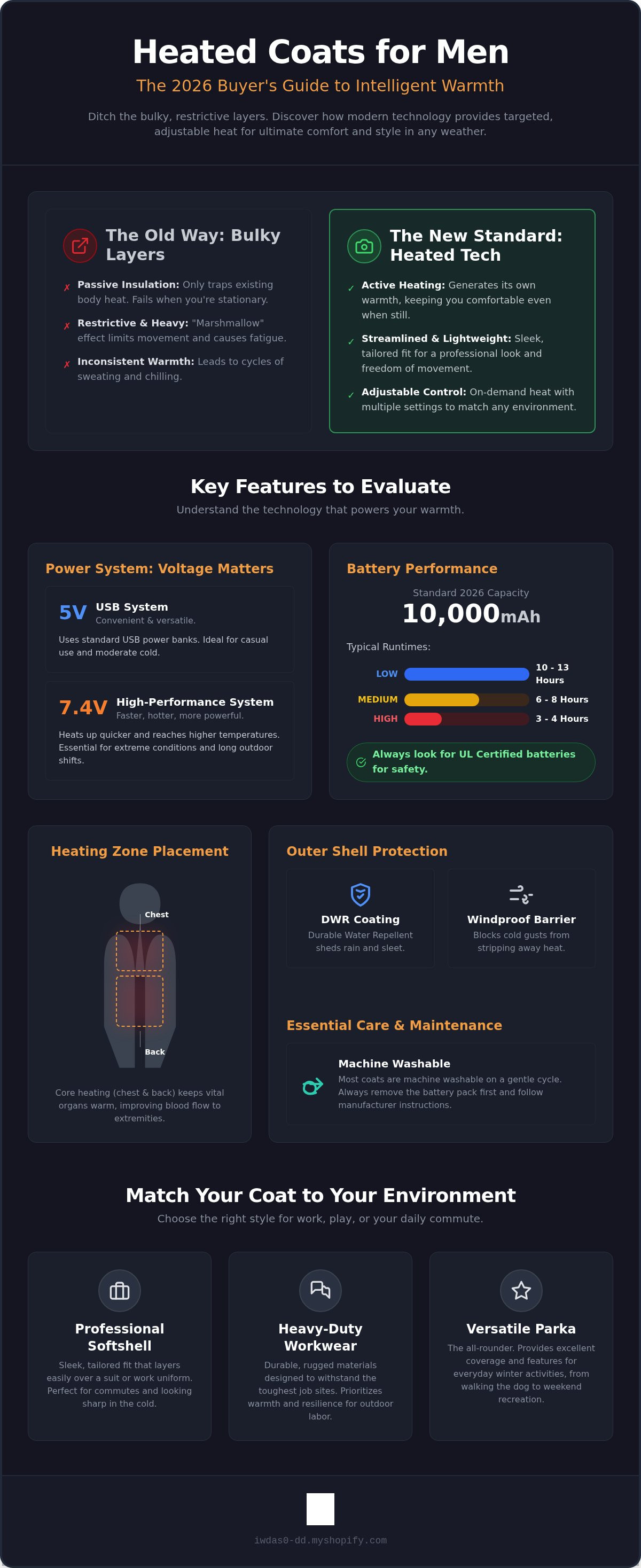
Traditional insulation like down or synthetic fill works by trapping your own body heat. This is passive. If your core temperature drops because you are stationary, there is no heat to trap. Carbon fiber heating elements change this dynamic by actively generating warmth. These elements are usually placed in the chest and back to keep your vital organs warm; this allows your blood to flow freely to your extremities. Active heating tech is the 2026 standard for outdoor professionals.
Breaking the Bulk: The Style Factor
One of the biggest reasons men are switching to tech-integrated gear is the silhouette. You no longer need a three-inch-thick coat to survive a blizzard. Because the heat comes from the internal elements, the outer shell can be thinner and more tailored. Modern heated coats for men offer a level of versatility that traditional heavy wool parkas simply cannot match.
- Professional Look: Sleek softshells that fit over a suit or work uniform without looking like camping gear.
- Climate Adaptability: One coat that works in 40-degree rain or sub-zero snow by simply adjusting the power setting.
- Reduced Fatigue: Lightweight materials mean less strain on your shoulders during a long day of movement.
Choosing these coats is about selecting a tool that works with you. It is the end of the "marshmallow" era of winter fashion.
Key Features to Evaluate When Buying a Men's Heated Jacket
Finding the right heated coats for men requires looking past the fabric. You're buying a piece of hardware as much as a piece of clothing. It's easy to get distracted by flashy designs, but the real value lies in the specs that keep you warm when the temperature drops below zero. Let's break down the technical framework you should use to make your choice.
Voltage is your first major decision. Most systems run on either 5V or 7.4V. A 5V system is convenient because it's USB-compatible, meaning you can often use a standard power bank. However, 7.4V is the high-performance choice. It heats up faster and reaches higher temperatures, which is essential for those working long shifts in extreme conditions. Modern designs are increasingly efficient, often incorporating Stanford University research on advanced thermal fabrics to ensure that every bit of battery power is converted into usable warmth.
Don't ignore the outer shell. A Durable Water Repellent (DWR) coating and windproofing are your first lines of defense. If your coat gets soaked with sleet or slush, the heating elements have to work twice as hard to keep you warm. A quality windproof barrier keeps that precious heat from being stripped away by a cold breeze.
Battery Tech: Powering Your Winter
Battery capacity is measured in milliamp-hours (mAh). A 10,000mAh battery is standard for 2026 models, typically providing about 10 hours of heat on the lowest setting. Some specialized models can even push toward 13 hours. While universal USB power banks offer flexibility, proprietary batteries are often shaped to fit discreetly in the jacket's pocket without creating a bulky lump. Always check for UL certification to ensure the battery has overcharge protection and meets modern safety standards.
Heating Zones and Heat Settings
The "golden trio" of heating zones includes the chest, back, and neck. Warming your core is the most effective way to keep your blood flowing to your fingers and toes. Adjustable heat levels (Low, Medium, and High) are non-negotiable. They allow you to manage your energy usage as the day warms up or your activity level changes. Inferior jackets often leave out the collar or shoulders, creating "cold spots" where heat escapes. High-quality heated coats for men ensure these areas are fully integrated for total coverage.
If you are ready to stop shivering, you might want to look at a curated Heated Jacket that balances these technical specs with a sleek, wearable design.
Matching Your Environment: Choosing the Right Style for Work, Play, or Commute
Not every winter day looks the same. A Tuesday morning in a city high-rise requires a different level of gear than a Saturday spent on a construction site or a Sunday in a freezing football stadium. Selecting the right heated coats for men starts with identifying where you'll spend most of your time. If you choose a heavy-duty canvas coat for a subway commute, you'll feel weighed down. If you take a sleek softshell to a rugged job site, it might not last the week.
For the professional commuter, the goal is invisible tech. You want a sleek softshell fabric and a discrete battery pocket that doesn't ruin the line of your coat. These designs are built to look like standard high-end outerwear, allowing you to walk into a boardroom without anyone knowing you've got a personal heater running. Contrast that with the outdoor laborer. For these men, heavy-duty canvas and reinforced seams are essential. The heating elements are a bonus to a coat that must first survive abrasion, sparks, and rough handling.
Weekend adventurers and sports fans have different needs. If you're hiking or camping, a lightweight puffer is the best choice. These provide excellent heat retention while remaining easy to pack. For the sports fan, battery life is the primary concern. Sitting on a cold stadium bench for four hours is the ultimate test of "static cold" endurance. You'll want a coat that can run on high for the duration of the game without fading in the fourth quarter.
Workwear vs. Casual Styles
The main difference between these styles lies in the outer material. Casual jackets often use lightweight nylon, which is great for movement but can snag easily. Workwear versions utilize Cordura-style fabrics that resist tears. Many modern professionals also look for "stealth" heating buttons. These are power switches that don't glow brightly, making them perfect for office-to-field transitions. If you're just starting your search, check out The Ultimate Guide to Choosing Your First Heated Jacket in 2026 for more on these specific fabric choices.
The Hybrid Approach: Versatility in 2026
The newest trend in heated coats for men is the mid-layer design. These are thinner jackets intended to be worn under a suit jacket or a heavy parka. It gives you a modular system that you can adjust as the temperature changes throughout the day. Heated vests have also seen a massive rise in popularity for this reason; they keep your core warm while leaving your arms free for work or sports. When deciding on your setup, you might wonder about other options. We've compared these tech-heavy choices in our look at Heated Jacket vs. Electric Blanket: Which 2026 Winter Essential Wins? to help you find your perfect fit.
Maximizing Performance: Battery Care and Safety Standards for Heated Apparel
A high-quality piece of tech-integrated outerwear is an investment. While heated coats for men are built for the elements, their internal components require specific care to ensure they perform season after season. Many owners worry about the safety of wearing electronics in the rain or the complexity of laundry day. In reality, modern heating systems are remarkably resilient, provided you follow a few basic rules for maintenance and storage.
One of the most persistent myths is that heated apparel is dangerous in wet weather. This isn't the case. These systems operate on low-voltage DC power, typically between 5V and 12V. Even if the jacket were to get completely soaked, there is no risk of a dangerous electric shock. Most internal wiring is sealed in waterproof casing. Your primary concern in the rain is actually protecting the battery and the connection port. Keep the battery pocket zipped, and let the coat dry completely before your next use.
If your coat stops heating, don't panic. Most issues are related to the connection point. Check for lint in the battery port or ensure the cable is fully seated. If the power button flashes a specific color, consult your manual; this usually indicates a battery that needs a fresh charge or a safety shut-off due to a loose connection.
Washing and Drying Your Tech
Yes, you can wash your coat. Before you start, always remove the battery and tuck the power cable back into its pocket, securing any zippers. Use a gentle cycle with cold water and a mild detergent. You should never use bleach or dry cleaning chemicals; these can degrade the bonds of the heating elements and ruin the internal wiring. For a deeper dive into the materials used, see The Science of Stay-Warm: A 2026 Guide to Modern Heated Clothing.
When it comes to drying, air-drying is the safest route. High-heat tumble drying can melt the insulation around the wires or damage the DWR coating we discussed earlier. If you must use a dryer, use the lowest heat setting possible and remove the coat while it's still slightly damp to finish air-drying on a sturdy hanger.
Battery Longevity and Safety
Your battery is the heart of the system. To maximize its lifespan, avoid extreme charging habits. Storing a battery at 0% for months can lead to a "deep discharge" that prevents it from ever charging again. Conversely, leaving it at 100% in a hot closet can stress the cells. Aim for about 50% charge before putting it away for the summer. If you notice the battery swelling, getting unusually hot, or losing its charge in under an hour, it's time for a replacement. To ensure you have the most reliable gear, consider picking up a high-performance Heated Jacket from a trusted curator.
Discovering Your Perfect Fit: Why Green Team Express is Your Winter Partner
Winter shouldn't be something you simply endure. At Green Team Express, we believe that the right gear turns a freezing morning into a comfortable start to your day. We've spent years watching the evolution of outdoor apparel, and we've seen how heated coats for men have moved from niche gadgets to essential survival tools. Our team acts as your dedicated curator. We've done the hard work of searching through endless specifications and battery types so you don't have to.
Every Heated Jacket in our collection has been vetted for more than just warmth. We look at the durability of the seams, the reliability of the connectors, and the overall safety of the battery systems. Selecting the best heated coats for men shouldn't be a guessing game. We know you need gear that works as hard as you do, whether you're on a professional job site or a weekend hike. By focusing on quality and uniqueness, we bridge the gap between complex manufacturing and your daily reality.
A Curated Discovery Experience
We don't believe in overwhelming you with technical jargon. Instead, we offer a friendly guide to finding what works. Our focus on a functional lifestyle means we prioritize items that solve real-world problems, like inconsistent warmth or bulky layers. We act as a bridge between the manufacturer and you, ensuring a personal touch in every transaction. It's about more than just a sale; it's about making sure you're prepared for whatever 2026 throws your way.
Ready to Upgrade Your Winter?
Before you make your final choice, run through this quick checklist to ensure your new gear meets your needs. It's the best way to guarantee satisfaction before the first snow falls.
- Size and Layering: Will you wear this over a suit or as a standalone piece?
- Battery Type: Do you prefer universal USB flexibility or a high-performance proprietary battery?
- Intended Use: Are you looking for professional softshell style or rugged workwear durability?
Finding the right fit doesn't have to be a chore. We've simplified the process so you can move from confusion to confidence. It's time to reclaim your winter. Explore our curated collection of heated jackets today and find the perfect partner for the cold months ahead.
Step into a Warmer Winter Tomorrow
The days of choosing between looking professional and staying warm are finally over. By embracing the shift from passive insulation to active technology, you can navigate the coldest months of 2026 with confidence. Remember to prioritize the "golden trio" of heating zones and maintain your battery health to ensure your gear lasts for years. Whether you're working an outdoor shift or commuting through the city, the right choice in heated coats for men provides a reliable microclimate that adapts to your needs.
We've done the hard work of vetting the latest technology so you can shop with total peace of mind. Our expertly curated selection focuses on durability, safety, and modern style. With our secure Shopify checkout, finding your next winter essential is a low-friction and rewarding experience. It's time to stop dreading the forecast and start enjoying the season. Shop our curated selection of high-performance heated coats for men today and feel the difference that high-tech warmth makes.
Frequently Asked Questions
Are heated coats safe to wear in the rain or snow?
Yes, it's safe to wear them in wet conditions because they use low-voltage power, typically between 5V and 12V. Most internal wiring is sealed in waterproof casing to prevent issues. While the fabric often has a Durable Water Repellent (DWR) coating, you should still keep the battery pocket zipped. If the coat gets soaked, just turn it off and let it dry completely before using it again.
How long does the battery typically last on a single charge?
Battery life depends on the heat setting and the battery's capacity. A standard 10,000mAh battery typically lasts about 10 hours on the low setting. If you switch to high, you might get 3 to 4 hours of intense warmth. Some high-performance heated coats for men feature advanced batteries that can push runtime up to 13 hours on low, making them perfect for full work shifts.
Can I use my own USB power bank with a heated jacket?
You can use your own USB power bank if the coat is a 5V system. Many modern jackets are designed with universal USB ports to give you more flexibility. However, high-performance 7.4V systems usually require a proprietary battery to reach higher temperatures. Always check the voltage and connection type before swapping batteries to ensure you don't damage the internal heating elements or the power port.
Are heated coats machine washable?
Most modern heated apparel is machine washable. You must remove the battery and tuck the power cable into its pocket before starting the laundry. Use a gentle cycle with cold water and avoid bleach or harsh chemicals. It's best to air-dry the garment rather than using a high-heat tumble dryer, as extreme heat can degrade the internal wiring and the outer fabric's water-resistant coating over time.
Can I wear a heated coat on an airplane?
You can definitely wear these coats on an airplane, but you have to follow battery regulations. Most heated jackets use lithium-ion batteries, which the FAA requires to be stored in your carry-on luggage. You shouldn't pack the battery in your checked bag. Once you're on the plane, it's generally fine to wear the coat, though you probably won't need the heating elements in the climate-controlled cabin.
How many heating zones do I really need for maximum warmth?
Most experts recommend at least three heating zones for effective warmth. The "golden trio" includes the chest and back to keep your core warm, which helps maintain blood flow to your hands and feet. Some advanced heated coats for men add a fourth or fifth zone in the collar or pockets. While more zones provide more coverage, they also drain the battery faster, so look for a balance.
What happens if the heating elements get wet?
If the internal heating elements get wet, the low-voltage design prevents any risk of dangerous electric shock. The electronics are typically sealed to handle moisture from sweat or light rain. If your jacket becomes saturated, the best practice is to power it down and remove the battery. Let the garment air-dry completely on a hanger before you attempt to turn the heat back on for your next trip.
Do heated coats come in different sizes and fits for men?
These coats come in a wide variety of styles to fit different body types and activities. You can find sleek, slim-fit softshells for professional commutes or rugged, relaxed-fit canvas coats for heavy labor. When choosing your size, consider what you'll wear underneath. A snug fit is usually better for heat transfer, but you still need enough room for a light mid-layer if you plan to wear it unpowered.