
What if you could leave your bulky, four-layer winter coat in the closet and still feel like you're wrapped in a warm blanket during a blizzard? For years, staying warm in sub-zero temperatures meant sacrificing mobility for heavy down and fleece. You've likely felt the frustration of restricted movement or the fear that a battery might die right when the wind picks up. Choosing your first heated jacket shouldn't feel like a gamble with your safety or your comfort.
We know you want reliable warmth without worrying about electrical shocks or complicated care. It's about finding that perfect balance of utility and novelty. This guide simplifies the science for you. You'll learn exactly how to choose a garment that fits your activity level. We'll compare 5V systems for casual commutes against 7.4V setups for serious outdoor adventures. We'll also dive into the new August 2026 safety standards, like GB/T4706.8-2024, so you can shop with total confidence. From graphene heating zones to battery life secrets, let's find your perfect fit.
Key Takeaways
- Learn how carbon fiber elements use Far-Infrared technology to provide deep, consistent warmth that outperforms traditional bulky layers.
- Understand the differences between 5V, 7.4V, and 12V power systems to match your battery runtime to your specific outdoor activities.
- Gain total peace of mind by debunking safety myths and mastering the simple steps for machine-washing your high-tech gear safely.
- Discover how to select a heated jacket that balances style and function, ensuring you stay cozy in sub-zero environments without the extra weight.
- Explore how a curated approach to outdoor apparel helps you find a reliable thermal solution for your daily commute or weekend adventures.
What is a Heated Jacket and How Does it Change Winter Travel?
Imagine stepping into a freezing morning without the usual four layers of wool and polyester. That is the reality of owning a heated jacket. For decades, we relied on "passive insulation." This means we used materials like down or fleece to trap our own body heat. If you weren't moving enough to generate heat, you stayed cold. A heated jacket changes the game by using "active heating." It doesn't just hold heat; it creates it.
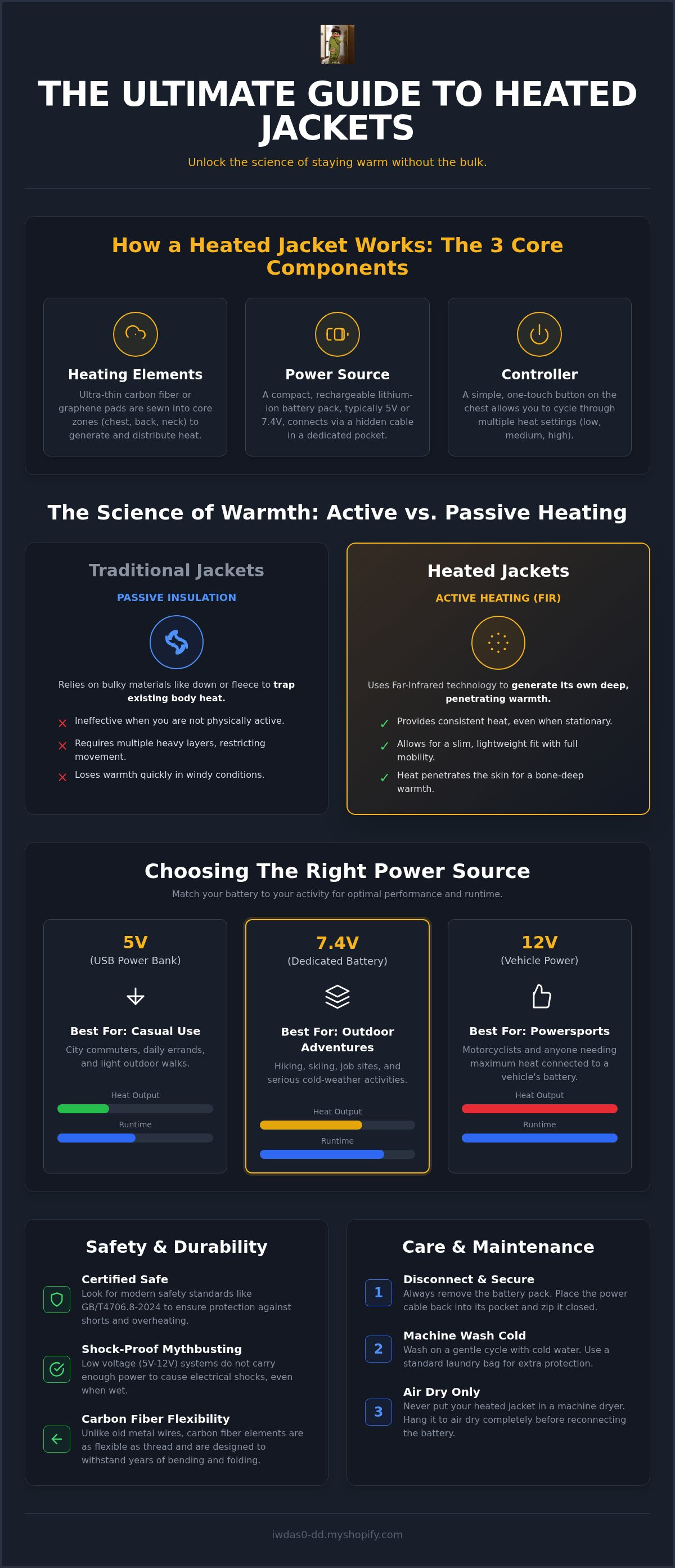
To understand What is a Heated Jacket, you only need to look at three core parts. First, there are the heating elements. These are thin, flexible pads sewn into the lining. Second, you have the battery pack, usually a lightweight lithium-ion unit hidden in a dedicated pocket. Finally, there is the controller. This is typically a discreet button on the chest that lets you toggle between heat levels. By 2026, these components have become so small and efficient that heated apparel is no longer just for extreme athletes. It's now a staple for the everyday commuter.
The Evolution of Cold Weather Apparel
We've come a long way from the heavy, itchy wool coats of the past. The shift toward lightweight heated softshells represents a major leap in textile engineering. In the past, staying warm meant looking like a marshmallow. Active heating removes the need for that bulky layering. You can wear a slim, stylish jacket that performs better than a heavy parka. Modern designs now focus on "stealth tech." This means the heating components are invisible to the eye, allowing the garment to look like high-end streetwear. It's about finding that intersection of utility and fashion.
Who Benefits Most from Heated Clothing?
While anyone in a cold climate can enjoy the warmth, certain groups find these jackets life-changing. They solve the problem of staying warm when you aren't physically active enough to generate your own heat.
- Outdoor Workers: On job sites where temperatures drop below zero, maintaining core warmth is a safety issue. Heated gear keeps muscles limber and reduces the risk of cold-related injuries.
- City Commuters: If you spend time waiting on a drafty train platform or walking between bus stops, a heated jacket provides immediate relief. It turns a miserable commute into a comfortable stroll.
- Recreational Adventurers: Hikers, skiers, and motorcycle riders often face high wind chills. Active heating allows them to stay out longer without the weight of extra gear.
It is about reclaiming your time outdoors. You no longer have to wait for the weather to cooperate to enjoy your favorite activities or get to work safely.
The Science of Warmth: How Carbon Fiber Heating Elements Work
Most people assume a heated jacket works like a toaster, using glowing coils to bake the air around you. The reality is much more sophisticated. Modern garments rely on Far-Infrared (FIR) technology. Instead of just warming the fabric, these systems emit light waves that penetrate the skin to warm your core directly. Far-Infrared heat is a safe, bone-deep warmth. It mimics the natural feeling of standing in direct sunlight on a crisp winter day, providing comfort that stays with you even after you turn the power off.
Carbon Fiber vs. Metal Wire Elements
Early versions of heated gear used copper or silver wires. These were stiff, heavy, and prone to "fatigue," a fancy term for snapping after you've folded your jacket a few times. Carbon fiber changed everything. These elements are as thin as a human hair and as flexible as silk thread. You can't feel them through the lining, and they don't restrict your movement when you're reaching for a ski pole or steering a bike. Because carbon fiber is an incredibly efficient conductor, it reaches its target temperature in seconds rather than minutes. It's the gold standard for anyone who values durability over several seasons of use.
Where these elements are placed matters just as much as what they're made of. Most high-quality jackets focus on three primary zones: the left and right chest and the mid-back. This layout targets your vital organs and large muscle groups to keep your blood circulating freely. Some advanced models also include a neck heating zone to block drafts. For the best results, look for a jacket with high-loft insulation. This padding acts as a thermal barrier, preventing the heat from escaping into the cold air. If you're ready to see this tech in action, you can explore our curated collection of high-performance gear.
Heat Management and Temperature Control
Control is the key to all-day comfort. You don't always need maximum power, especially if you're moving between a cold street and a warm bus. Modern jackets use an LED-backlit controller, usually located on the chest, to manage the battery's output. A standard three-level system allows you to toggle between settings:
- High (Red): Maximum output for extreme sub-zero exposure.
- Medium (White/Blue): The sweet spot for steady warmth during a commute.
- Low (Blue/Green): A gentle heat that preserves battery life for hours.
Safety is built into the logic of these controllers. Many 2026 models feature an automatic "pre-heat" mode that starts on high and drops to medium after five minutes. Thermal safety cut-offs also ensure the elements never exceed a safe temperature, protecting both the fabric and your skin from overheating.
Choosing the Right Power Source: 5V vs. 7.4V vs. 12V
Think of the battery as the heart of your heated jacket. Without the right power source, even the best carbon fiber elements won't reach their full potential. In 2026, you'll mostly choose between three voltage levels. Each fits a different lifestyle and environment. It's about matching the tool to the task.
- 5V USB Standard: This is the ultimate for convenience. These jackets use the same USB power banks you use for your phone. They're perfect for mild chills or indoor use, typically reaching 30 to 40°C.
- 7.4V System: This is the industry sweet spot. It provides a perfect balance of runtime and heat, reaching up to 65°C. Most 7.4V batteries can power five or six heating zones without feeling heavy.
- 12V Professional Grade: These are built for the harshest environments. They offer the fastest heating and can cover more zones, though the battery packs are often larger and more specialized.
When looking at capacity, you'll see a number followed by "mAh." A 10,000mAh battery is a standard choice. On a single charge, a quality battery should provide 6 to 12 hours of warmth. This depends entirely on whether you're using the high or low setting. Always check if the battery has safety certifications like UL 2054 or CE to ensure it handles the power safely.
Universal USB Batteries vs. Proprietary Packs
Using your own power bank is tempting. It's cheap and easy. However, proprietary batteries designed for a specific heated jacket often include better safety integration. They're built to handle the constant draw of heating elements. By 2026, most high-end brands have fully transitioned to USB-C ports. This allows for much faster charging times, often cutting your wait in half compared to older micro-USB models. It's a small upgrade that makes a huge difference on busy mornings.
Maximizing Battery Life in Extreme Cold
Sub-zero temperatures are tough on lithium-ion batteries. Extreme cold can cause them to drain faster than expected. To fight this, keep your battery in its designated internal pocket. Your body heat will help it stay efficient. If you're on a long trek, try "pulse" heating. Instead of leaving the jacket on "high" for hours, use the high setting for ten minutes to get warm. Then, drop it to "low" to maintain that temperature. This simple trick can extend your runtime by several hours. When the season ends, store your battery at about a 50% charge in a cool, dry place. This keeps the cells healthy for next winter.
Safety, Care, and Durability: Addressing Common Concerns
One of the most common questions we hear is simple. "Is it safe to wear a heated jacket in the rain?" The idea of mixing electricity with water feels risky. However, these garments are designed with multiple layers of protection. The heating elements are sealed in waterproof membranes. Even if you're caught in a sudden downpour, the low voltage of a 5V or 7.4V system is far too weak to cause an electrical shock. It's built for the real world, not just for dry days.
Is a Heated Jacket Safe to Wear in the Rain?
Modern thermal gear relies on high-tech shell materials. Most use a Durable Water Repellent (DWR) coating to bead water off the surface. Underneath, a breathable membrane allows sweat to escape without letting rain in. The internal power connector is also waterproof. This ensures the connection between your battery and the jacket stays dry and functional. Beyond water safety, many users worry about invisible risks. You can rest easy knowing that heated jackets emit no harmful EMF radiation. They're as safe as the smartphone in your pocket.
For professional users, safety standards have reached new heights. The August 2026 implementation of the GB/T4706.8-2024 standard has tightened regulations on temperature limits. This means your gear is smarter and safer than ever before. If you're looking for a reliable, safety-tested option, check out our latest heated jacket arrivals today.
Washing and Maintenance for Longevity
You don't need to treat your jacket like a delicate artifact. Most are fully machine washable. Follow these steps to keep your gear in top shape for years:
- Remove the Battery: This is the most important step. Never put the battery in the wash.
- Secure the Cable: Place the internal power cable back into its pocket and zip it shut. This prevents the connector from snagging.
- Use a Mesh Bag: A laundry bag protects the heating elements from being pulled or twisted during the spin cycle.
- Gentle Cycle Only: Use cold water and a mild detergent. Never use bleach or fabric softeners, as these can degrade the waterproof coatings.
Drying is just as critical. Avoid the dry cleaners at all costs; the chemicals used in the process can damage the internal wiring. Air drying is the safest method. If you must use a dryer, set it to the lowest heat possible. High heat can melt the adhesive that keeps the heating elements in place. Once it's completely dry, your jacket is ready for your next adventure.
Finding Your Perfect Match at Green Team Express
Many big catalogs leave you feeling lost. You scroll through hundreds of nearly identical items without knowing which one actually works. We take a different approach. At Green Team Express, Llc, we act as your dedicated guide. We've done the hard work of searching for the best tech so you don't have to. Our focus is on functional lifestyle solutions that bridge the gap between high-tech manufacturing and your daily routine. We're a small, passionate team that values both practicality and a sense of wonder in every product we curate.
When you choose a heated jacket, the fit is more than just a style choice. It's about thermal efficiency. You want the heating elements to sit close to your body. If the jacket is too loose, the heat escapes into the air gaps before it ever reaches your skin. A snug fit ensures the carbon fiber elements can transfer warmth directly to your core. We recommend taking your measurements while wearing a light base layer. This helps you find that perfect, cozy balance that maximizes the battery's performance.
Softshell vs. Puffer vs. Fleece Styles
Every lifestyle has its own demands. If you're active, a softshell is your best bet. These are wind-resistant and offer the flexibility needed for hiking, cycling, or active work sites. For those who face extreme, stationary cold, a puffer jacket is the clear winner. The extra insulation traps the heat generated by the elements, creating a personal micro-climate. If you mostly need a boost while working in a chilly office or want a layer under a heavy rain shell, a heated fleece is a versatile find. It's lightweight enough for indoor use but powerful enough to make a difference.
Ready for Winter: Your Next Steps
Winter doesn't have to be a season of shivering. You're now equipped with the knowledge to choose gear that is safe, efficient, and perfectly suited to your needs. Our secure Shopify-based store makes it easy to find exactly what you're looking for without the stress of high-pressure sales. We invite you to Explore our curated heated jacket collection and find the piece that makes your next cold-weather outing an adventure instead of a chore. Check our listings for current shipping information and seasonal updates to ensure you're ready before the first frost hits.
Step Into the Future of Winter Comfort
Staying warm in 2026 doesn't mean hiding under a mountain of heavy fabrics. You've seen how carbon fiber elements and Far-Infrared technology transform a standard coat into a precision thermal system. Whether you're choosing a 5V system for light commutes or a 7.4V setup for rugged adventures, you now have the tools to stay cozy in any sub-zero environment. Safety is no longer a question; it's a standard you can trust. Proper care and the right fit ensure your heated jacket remains a reliable companion for many seasons to come.
At Green Team Express, we've done the hard work of vetting the best gear for your lifestyle. We're proud to offer expertly curated outdoor gear that bridges the gap between high-tech manufacturing and your daily needs. When you shop with us, you get a secure US-based checkout and a dedicated team ready to support you. It's time to reclaim your winter adventures without the bulk. We invite you to Shop our curated collection of high-performance heated jackets today. You don't have to wait for the weather to change to start feeling comfortable again.
Frequently Asked Questions
Can I use any power bank with my heated jacket?
You can use a standard power bank if your jacket is designed for the 5V USB standard. These are the same portable chargers used for smartphones. However, if you have a 7.4V or 12V system, you must use the proprietary battery pack designed by the manufacturer. Using a third-party battery with the wrong voltage can damage the heating elements or lead to poor thermal performance. Always check the connector type and voltage rating first.
How long does the battery actually last on the highest setting?
On the highest heat setting, most standard 10,000mAh batteries will last between 2 and 3 hours. This is because the high setting draws the maximum amount of power to maintain peak temperatures, often up to 65°C. To get through a full day outdoors, try using the high setting to warm up initially and then switching to medium or low. This simple strategy can extend your total runtime to 8 or 10 hours.
Are heated jackets allowed on airplanes and in carry-on luggage?
Yes, you can take a heated jacket on a plane, but there are specific rules for the lithium-ion battery. The TSA and FAA require that all lithium batteries be disconnected and kept in your carry-on luggage. You should never pack the battery in checked bags due to fire safety regulations. The jacket itself can be worn through security or packed anywhere, as long as the power source is removed and handled separately.
Do heated jackets protect against radiation or EMF?
Heated apparel does not emit harmful levels of Electromagnetic Field (EMF) radiation. Most systems use low-voltage Direct Current (DC) power, which produces a negligible EMF signature compared to everyday household appliances or cell phones. The carbon fiber elements are designed for thermal efficiency rather than signal transmission. You can wear your garment all day without worrying about radiation exposure, as the technology is centered entirely on safe, Far-Infrared heat waves.
What happens if the heating elements get wet?
Nothing dangerous happens if the heating elements get wet because they are encased in a waterproof coating. The low voltage used in a heated jacket is not enough to cause an electrical shock even in a downpour. If your jacket becomes soaked, simply turn off the power and remove the battery. Once the garment is completely dry, you can safely resume using the heating functions without any risk of damage to the internal circuitry.
How do I know what size heated jacket to buy?
You should aim for a snug fit rather than a loose one. Since the heating elements need to be close to your body to transfer warmth effectively, a jacket that is too large will leave cold air gaps. Most manufacturers provide specific size charts based on chest and waist measurements. We suggest measuring yourself while wearing the light base layer you plan to use most often. This ensures the elements sit right against your core.
Can I wear a heated jacket if I have a pacemaker?
You should consult your physician before using any battery-powered apparel if you have a pacemaker or other implanted medical device. While the EMF levels are extremely low, medical professionals generally recommend keeping electronic devices a safe distance from cardiac equipment. Your doctor can provide guidance based on the specific model of your pacemaker. It's always better to prioritize medical safety by getting a professional opinion before introducing active heating elements near your chest.
Is it okay to wear a heated jacket as a base layer?
It's not recommended to wear a heated garment directly against your skin. For the best experience, you should wear a thin, moisture-wicking base layer underneath. This protects your skin from direct contact with the heating zones and helps distribute the warmth more evenly. Wearing a base layer also prevents sweat from building up directly on the jacket lining, which keeps your gear cleaner and more comfortable during high-activity tasks or long winter walks.