
The best way to slash your winter energy bill might actually involve wearing your heater instead of sitting under it. Most of us are used to the cozy comfort of a throw, but the debate of heated jacket vs electric blanket is heating up as we look for smarter ways to stay warm. You likely feel the frustration of rising electricity costs and the annoyance of being tethered to a wall outlet by a cord. It's hard to stay productive when you're buried under bulky layers that still leave you with stubborn cold spots.
In this guide, you'll discover whether a portable heated jacket or a traditional electric blanket is the better investment for your lifestyle and your wallet this year. We're diving into the specifics of battery life, mobility, and energy efficiency to see which one truly wins. We'll compare how these tools handle everything from outdoor adventures to quiet office work. By the end, you'll know exactly which high-performance tool will keep you toasty through the sub-zero months ahead.
Key Takeaways
- Learn why modern battery technology is shifting the focus from heating entire rooms to heating your body directly for better efficiency.
- Explore the technical differences in a heated jacket vs electric blanket to decide between the mobility of lithium-ion batteries or the steady power of a cord.
- Weigh the "Freedom Factor" of wearable gear against the deep-sleep recovery benefits of traditional full-body coverage.
- Compare the "Cost to Warm" for different devices to see which option keeps your 2026 energy bills as low as possible.
- Get a first look at the new hybrid heating solutions that offer blanket-style comfort with the portability of a jacket.
The Evolution of Personal Heating: Why We Are Moving Beyond the Plug
For decades, staying warm meant turning up the thermostat and heating every cubic inch of a room. It's an expensive, inefficient way to live. Today, the focus has shifted toward heating the individual rather than the architecture. This change represents a major leap in energy efficiency. Instead of waiting for a furnace to kick in, we're creating a "wearable micro-climate" that stays with us wherever we go. It's a more personal, direct approach to comfort.
When comparing a heated jacket vs electric blanket, the most striking difference is how you move through your day. A blanket is a destination; a jacket is a companion. By 2026, battery technology has reached a point where high-capacity power banks are light enough to disappear into a pocket while providing heat for up to 12 hours on a single charge. This accessibility has turned wearable heat from a niche outdoor tool into a daily necessity for everyone from commuters to home-office workers.
The Problem with Tethered Warmth
Traditional Electric blanket technology relies on a physical connection to a wall outlet. This creates a "static" lifestyle. You're essentially trapped on the couch or in bed. You can't grab a snack, answer the door, or finish chores without unplugging and losing your heat source. It limits your productivity and keeps you tethered to specific "warm spots" in the house. There's also the safety aspect to consider. Modern wearables use low-voltage DC power (5V or 7.4V), which is much safer than the high-voltage AC power used in older corded textiles. Today's consumer prioritizes gear that moves with them.
The Rise of Smart Apparel in 2026
We've moved past the days of stiff wires and heavy battery packs. The current heated clothing revolution uses flexible carbon fiber heating elements. These are woven directly into the fabric, making the gear feel like a standard premium jacket. The aesthetics have caught up too. You don't look like a walking gadget anymore. You look like you're wearing a stylish, well-fitted piece of outerwear that happens to have a hidden superpower. This integration allows you to transition from a cold morning commute to a chilly office without ever losing your personal warmth. It's about maintaining an active lifestyle regardless of the temperature outside.
Battery-Powered Jackets vs. Corded Electric Blankets: The Technical Breakdown
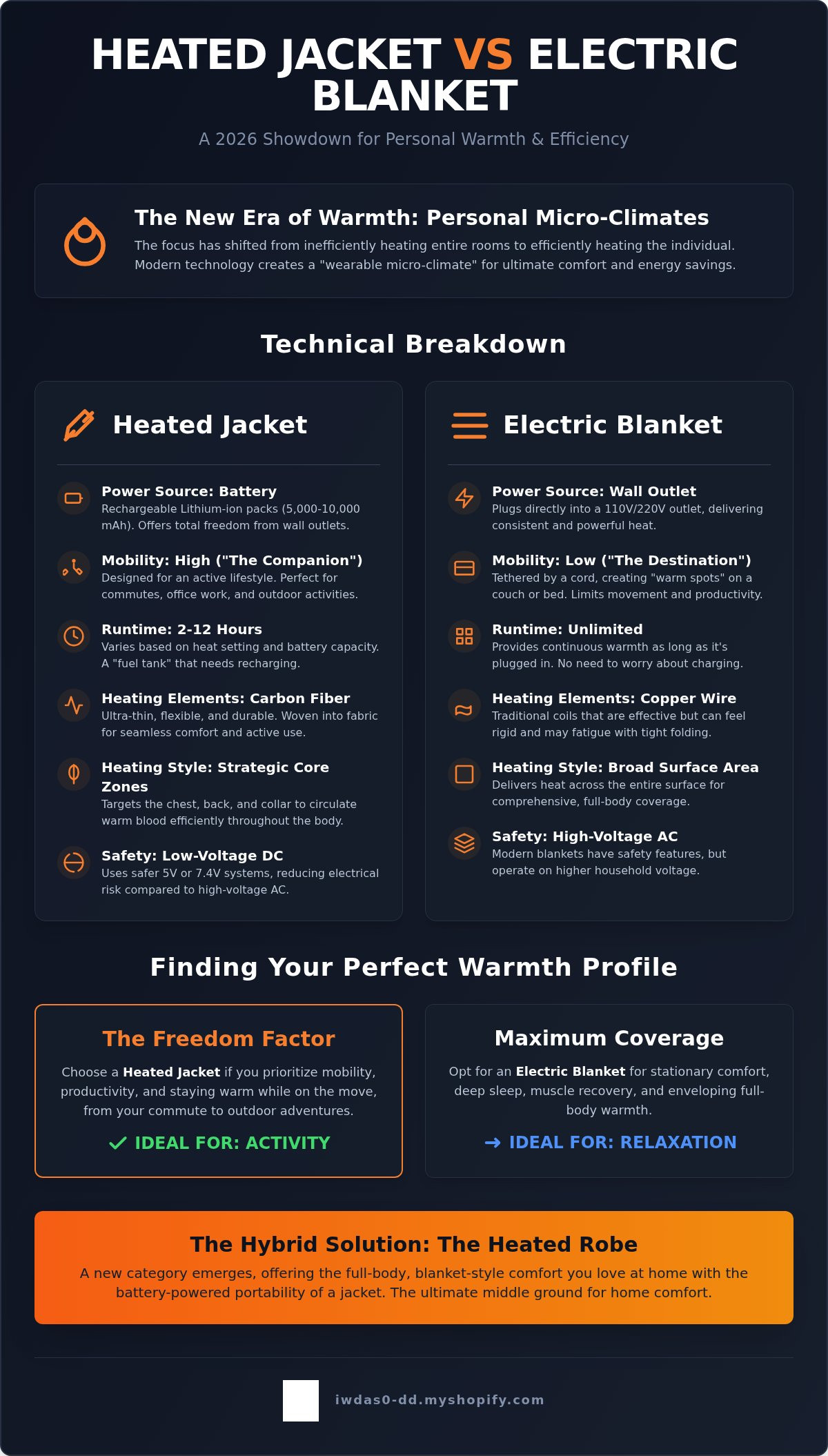
Choosing between a heated jacket vs electric blanket often comes down to the hardware hidden beneath the fabric. The power source is the most obvious divide. Standard 110V or 220V wall outlets provide the muscle for electric blankets. This setup offers unlimited runtime and high heat intensity, but it keeps you pinned to one spot. In contrast, heated jackets rely on rechargeable lithium-ion packs. These batteries, typically ranging from 5,000 to 10,000 mAh, offer between 2 and 12 hours of warmth depending on your settings. While the jacket has a "fuel tank" that eventually runs dry, the trade-off is total independence from the grid.
The heating elements themselves have also evolved. Most traditional blankets still use thin copper wire coils. These are effective but can feel "bumpy" through the fabric and may eventually fatigue if the blanket is folded tightly. Modern jackets utilize carbon fiber heating elements. Carbon fiber is incredibly thin, flexible, and durable. It doesn't just survive being folded; it thrives in active environments. While a blanket provides a broad surface area of heat for your whole body, a jacket focuses on strategic core zones like the chest, back, and collar to keep your blood circulating warmly to your extremities.
Understanding Voltage and Heat Intensity
Voltage defines how quickly and intensely a garment can heat up. Many entry-level jackets use 5V USB systems. These are convenient because they're compatible with the same power banks you use for your phone. For those facing sub-zero temperatures, 7.4V systems are the professional standard. They provide a more aggressive heat punch that can withstand biting winds. Electric blankets don't have these voltage tiers because they pull directly from your home's power. This results in a very consistent, high-heat experience that is perfect for recovery or deep sleep, even if it lacks the portability of a battery-powered system.
Maintenance and Safety Standards
Durability is a common concern for tech-integrated textiles. You might worry about the wash cycle, but by 2026, both options have become remarkably resilient. Most units are machine washable as long as you remove the battery pack or corded controller first. Knowing how to maintain your heated jacket properly ensures the carbon fiber elements stay intact for 300 to 500 charging cycles. Safety features have also leveled up. Overheat protection and automatic shut-off timers are now standard across both categories. If you're ready to break free from the cord, exploring a modern heated outer layer is a great way to stay mobile without sacrificing safety.
Mobility vs. Maximum Coverage: Finding Your Perfect Warmth Profile
The choice of heated jacket vs electric blanket usually boils down to one word: mobility. Blankets offer maximum surface area. They're unparalleled for deep sleep or muscle recovery after a long day. If your goal is to stay completely horizontal for eight hours, the blanket is your best friend. But blankets have a frustrating flaw. Cold pockets. Every time you shift your legs or reach for a remote, the trapped heat escapes and icy air rushes in. It's a constant battle to stay tucked in.
Jackets wrap the heat directly against your skin. It's a snug, consistent warmth that doesn't care if you're walking the dog or sitting at a keyboard. By 2026, the "Freedom Factor" has become the deciding point for most buyers. We want warmth that follows us. We don't want to choose between being warm and being productive. Whether you're moving from the sofa to the fridge or the driveway to the office, the jacket maintains your personal climate without interruption.
The Remote Worker’s Dilemma
Working from home in a chilly house is a unique challenge. Bulky blankets are the enemy of productivity. They slide off your shoulders while you type and get tangled in your chair wheels. A heated jacket is the superior ergonomic choice for maintaining focus at a desk. It keeps your core temperature steady without the weight of heavy layers. You can stand up for a "camera-on" meeting or grab a coffee without losing your heat source. It's about staying sharp and comfortable without feeling like you're trapped in a cocoon.
Outdoor Versatility
This is where the jacket truly pulls ahead. An electric blanket is a homebound tool, but a heated jacket is a critical part of an outdoor survival kit. Blankets are useless in wind and moisture; they're designed for the controlled environment of a bedroom. A high-quality jacket acts as a powerful mid-layer. It works with your existing shells to block the elements while providing active heat. For anyone who refuses to stay inside just because the mercury dropped, the portability of battery-powered gear is a game changer. It turns a miserable winter hike into a comfortable morning stroll.
Efficiency and Cost: Which Solution Saves More on Your 2026 Energy Bill?
Heating an entire home is a luxury that many are reconsidering. In early 2026, running a standard 24kW gas boiler costs roughly £1.42 per hour. When you look at the heated jacket vs electric blanket debate through a financial lens, both options offer a massive relief for your wallet. However, the efficiency comes down to how much mass you're actually warming. It's a simple physics problem. Heating a 2-pound jacket that sits directly against your body is inherently more efficient than warming a 15-pound weighted blanket that loses heat to the room's air.
A typical 100W heated throw costs approximately 2.77p per hour to run on its highest setting. While that's already incredibly cheap, battery-powered gear takes it a step further. Because the heat is trapped under your outer layers, you don't need constant high-wattage draws to stay comfortable. You're focusing 100% of the energy on your core rather than the furniture around you.
The Micro-Heating Savings Strategy
Adopting a "heat the person, not the room" mindset can reduce your overall HVAC costs by up to 20%. By lowering your home thermostat just a few degrees and relying on personal heat, you'll see a noticeable drop in your monthly utility bill. Charging a 10,000 mAh battery pack in 2026 costs mere pennies. A heated jacket typically consumes less than 10 watts per hour. This low power draw means you can stay toasty for an entire workday for less than the cost of a single cup of coffee. It's a precise, tactical way to manage your winter budget without shivering through the morning.
Longevity and Value for Money
When you invest in winter gear, you have to look at the long-term ROI. A high-quality electric blanket is a great home textile, but its utility ends at the front door. A heated jacket provides much better value because it's multi-functional. You can wear it at your desk, then immediately head out for a hike or a commute without changing. This versatility effectively doubles the product's worth.
There are hidden costs to consider as well. Most jacket batteries are rated for 300 to 500 charging cycles, meaning they'll last several seasons of heavy use. In contrast, corded blankets often suffer from cord wear and tear or internal wire fatigue from frequent folding. If you're looking for a durable solution that works in every scenario, you can shop the latest energy-efficient gear to start saving today. High-tech apparel also tends to hold its resale value better than basic home blankets, making it a smarter asset for the modern consumer.
The Rise of the Heated Robe: The Ultimate Middle Ground for Home Comfort
The 2026 winter season has brought a new contender to the stage. For years, the choice was binary. You either chose the mobility of a jacket or the total immersion of a blanket. Now, the heated robe has emerged as the ultimate hybrid solution. It bridges the gap for those who want blanket-level comfort with jacket-level mobility. This trend reflects a broader shift in loungewear technology where functionality is just as important as softness. People are no longer satisfied with being warm only when they're stationary. They want the "stay-in-bed" feel without the "stay-in-bed" limitation.
The Best of Both Worlds
A high-quality heated robe offers full-length coverage that rivals any traditional throw. The difference lies in the design. With dedicated arm-holes and often foot pockets, you can move around your living space without losing your heat. These robes feature integrated battery pockets, allowing for a completely cord-free experience. You can brew a cup of tea or walk to the mailbox while wrapped in a literal cloud of warmth. It taps into the psychology of "cozy tech." It provides a sense of security and relaxation while maintaining the utility needed for a modern, active lifestyle. Look for models with multiple heating zones and machine-washable fabrics to ensure your loungewear lasts for several seasons.
Final Verdict: Choosing Your Winter Warrior
Deciding between a heated jacket vs electric blanket depends entirely on your daily rhythm. There isn't a single "correct" answer, only the one that fits your habits. Each tool has a specific role in a high-performance winter strategy.
A heated jacket is your champion if you prioritize mobility. It's the clear winner for remote desk work, outdoor adventures, and morning commutes. It acts as a tactical layer that keeps you productive and safe in sub-zero conditions. If you refuse to be tethered to a wall outlet, this is your primary tool.
On the other hand, the traditional electric blanket remains the king of recovery. It's the best choice for shared warmth on the sofa or for pre-heating your bed for deep sleep. If your winter goal is purely about relaxation and maximum surface area coverage, the blanket still holds its ground. It's a stationary solution for stationary moments.
Many savvy consumers in 2026 are finding that the ultimate winter hack is owning both. Use the jacket for your active hours and the blanket for your restorative ones. By layering these technologies, you can keep your home's central heating at a minimum while enjoying a personalized, high-performance climate all day long.
Step Into a Warmer, Cord-Free Future
Deciding on a heated jacket vs electric blanket comes down to how you want to live your winter. While blankets offer a classic way to relax, they can't match the versatility of wearable tech. You now know that 2026 carbon-fiber heating tech provides a targeted micro-climate that follows you from the home office to the outdoors. It's the ultimate way to stay productive without being tethered to a wall outlet.
Our collection features gear that is both lightweight and machine washable; it's a practical addition to any wardrobe. By focusing heat where you need it most, you'll save on energy while enjoying superior comfort. We provide nationwide US shipping so you can upgrade your winter setup quickly and easily. It's time to stop heating empty rooms and start investing in your own comfort.
Discover the freedom of portable warmth; shop our Heated Jacket collection today!
Don't let the cold dictate your schedule. Embrace the season with gear that works as hard as you do and enjoy the discovery of a truly cozy winter.
Frequently Asked Questions
Is a heated jacket warmer than an electric blanket?
A heated jacket provides more intense, targeted warmth than a blanket because it sits directly against your base layers. While an electric blanket covers a larger surface area, it loses heat to the surrounding room air. The carbon fiber elements in a jacket create a personal micro-climate that remains stable even if you move. In the heated jacket vs electric blanket debate, the jacket wins for heat retention, while the blanket wins for sheer coverage.
Can I sleep in a heated jacket safely?
It's best to avoid sleeping in a heated jacket. These garments are designed for active use or sitting upright. Sleeping in one can cause the heating elements to press too firmly against your skin, potentially leading to hot spots or discomfort. Electric blankets are specifically engineered with safety timers and flat wiring for long-term use in bed. For overnight warmth, a traditional heated throw or under-blanket is a much safer and more comfortable choice.
How much does it cost to run a heated jacket compared to an electric blanket?
Both options are incredibly cheap to run compared to central heating. An electric blanket typically costs about 2.77p per hour on high settings. A heated jacket is even more efficient, often drawing less than 10 watts. Charging a standard battery pack costs mere pennies in 2026. While the initial investment for a jacket is higher, the daily running costs are negligible. You'll likely see a significant drop in your utility bill by using either device.
Are heated jackets safe to wear in the rain or snow?
Yes, most modern heated jackets are designed to handle light rain and snow. The outer shells are typically water-resistant, and the internal electronics are sealed to prevent short circuits. You shouldn't submerge the jacket in water while the battery is connected, but a winter flurry won't cause any issues. This ruggedness makes them a superior choice for outdoor activities where an electric blanket would be completely impractical and potentially dangerous due to moisture.
Can I use a standard phone power bank to power my heated jacket?
You can use a standard phone power bank for any 5V USB-compatible jacket. This is a huge advantage for travelers who already carry portable chargers. However, professional-grade 7.4V systems require specialized batteries to reach higher temperatures for extreme cold. Always check the voltage requirements of your specific garment before plugging in a third-party pack. Using a high-capacity 10,000 mAh bank will typically give you several hours of consistent, reliable warmth throughout the day.
How long do the batteries last in a heated jacket in 2026?
In 2026, standard battery packs for heated apparel offer impressive longevity. You can expect 2 to 5.5 hours of heat on the highest setting. If you switch to a low or "eco" mode, many batteries will last between 8 and 12 hours. This range allows you to get through a full workday or a long outdoor event on a single charge. Most lithium-ion batteries are rated for 300 to 500 full charging cycles before they lose capacity.
Do heated jackets or electric blankets help with chronic pain?
Both devices offer excellent heat therapy for chronic pain and muscle stiffness. An electric blanket is ideal for full-body recovery while you're resting on the sofa or in bed. A heated jacket provides a different benefit by allowing you to manage pain while remaining active. The targeted heat on the back and chest can help soothe sore muscles during a commute or while working at a desk. It's a portable solution for ongoing comfort.
Which is easier to clean: a heated jacket or an electric blanket?
Both items are surprisingly easy to clean, but jackets often have the edge. Most modern heated jackets are machine washable once you remove the battery pack. Because they're smaller and less bulky than a 15-pound weighted blanket, they fit easily into standard home washers and dry faster. Many electric blankets are also machine washable, but you must be extra careful with the corded connectors and bulky fabric. Always follow the specific care label to protect the heating elements.