
Imagine spending your Saturday morning chasing a basketball through the rose bushes or, worse, into oncoming traffic. It's a common scene for anyone trying to master their shot at home without a basketball rebounder for driveway use. You want to focus on your form, but you're too busy playing fetch with a ball that has a mind of its own. Most players agree that the biggest hurdle to a better jump shot is the wasted time between attempts. It's hard to find a rhythm when you're constantly out of breath from sprinting after airballs instead of practicing your release.
Discover how to transform your driveway into a high-repetition training facility with the right basketball rebounder or shooting machine. This 2026 guide ensures you'll get more shots up in less time while keeping your ball within the court boundaries safely. We'll walk through the best options on the market, from elite shooting machines that return 1,000 shots per hour to simple, accessible tools like the Portable Mini Basketball Return Game. It's time to stop chasing missed shots and start building the muscle memory that wins games.
Key Takeaways
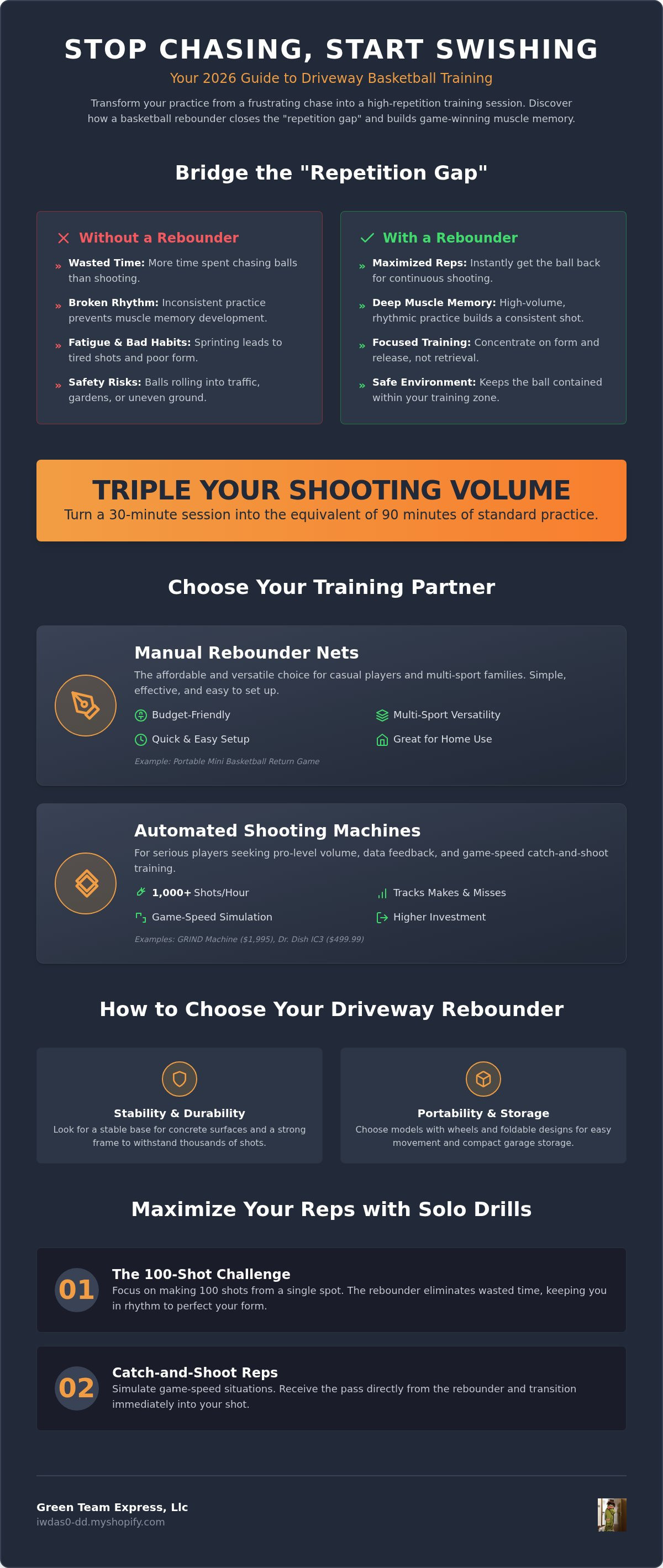
- Triple your shooting volume by bridging the "repetition gap" with a system that returns the ball instantly.
- Compare manual rebounder nets with automated shooting machines to find the right balance of cost and high-volume performance.
- Choose the perfect basketball rebounder for driveway setups by checking for stability on concrete and ease of storage.
- Boost your consistency using the 100-Shot Challenge and catch-and-shoot drills designed for solo training.
- Discover how compact solutions, such as the Portable Mini Basketball Return Game, make professional-style practice possible even on smaller courts.
Why Every Home Court Needs a Basketball Rebounder for Driveway Use
A basketball rebounder for driveway training is essentially a silent partner. It's a specialized system designed to catch missed shots and funnel the ball back to the shooter instantly. Most backyard players spend more time jogging after errant bounces than actually shooting. We call this the "repetition gap." Closing this gap can triple your shots per minute, turning a thirty-minute session into the equivalent of ninety minutes of standard play. As we move through 2026, the smart home court has become the standard for players who are serious about their development.
Safety is a major factor often overlooked. A quality rebounder acts as a barrier. It keeps the ball out of the street and away from parked cars or fragile garden beds. It's about peace of mind. You can focus on your follow-through instead of worrying about a ball rolling into traffic. It transforms a standard driveway into a secure, high-efficiency training zone.
The Problem with Manual Rebounding
Chasing balls isn't just annoying; it's a productivity killer. Fatigue from constant sprinting reduces the quality of your shooting form. When you're tired, you start taking shortcuts. Your elbow flares, or you stop using your legs. This creates bad habits that are hard to break. Interrupted rhythm also prevents the development of deep muscle memory. You need consistent, rapid repetitions to "program" your shot. There's also the physical risk. Running onto uneven grass or slick pavement to chase a ball is a recipe for a rolled ankle. A dedicated return system keeps you on the flat surface where you belong.
From Backyard to Pro Training
Professional athletes have long relied on high-volume tools. Many college programs use The Gun basketball shooting machine to ensure players get hundreds of reps in a single sitting. You don't need a pro budget to get these results at home anymore. Modern driveway systems allow you to simulate game-speed catches. There's a huge psychological benefit to seeing the ball return to you consistently. It builds confidence. You move from casual play to structured training. For a compact and accessible start, the Portable Mini Basketball Return Game is an excellent way to bring this professional rhythm to your own driveway. It helps you transition from just "shooting around" to actually getting better.
Manual Rebounder Nets vs. Portable Basketball Shooting Machine
Choosing a basketball rebounder for driveway use usually comes down to two paths. You can opt for the simplicity of a manual net or the high-tech power of an automated machine. Both systems serve a purpose. It depends on whether you're looking for a casual skill booster or a professional-grade training facility in your front yard. Manual nets are the unsung heroes of the backyard. They're affordable and set up in minutes. Most importantly, they aren't just for shooting. You can use them for chest passes, bounce pass accuracy, and even other sports like soccer or baseball.
Portable shooting machines are the heavy hitters of the industry. In 2026, models like the GRIND Machine ($1,995.00) or the Dr. Dish IC3 ($499.99) offer incredible volume. The GRIND Machine, for instance, can return up to 1,000 shots per hour. That's a massive jump from chasing balls by hand. These machines are designed for players who want to maximize every second of their practice time.
Understanding the Portable Basketball Shooting Machine
Electronic machines do more than just return the ball. Many 2026 models track makes and misses, giving you real-time data on your progress. Portability has improved significantly. Newer units feature rugged wheels and foldable frames that tuck into a garage corner easily. Battery life has also seen a boost, with many units running for several hours on a single charge. The real advantage here is "catch and shoot" training. You learn to receive the ball and transition into your shot immediately. This simulates game-time pressure better than shooting off the dribble alone.
The Versatility of Rebounder Nets
Don't dismiss the humble net. It's incredibly versatile. By adjusting the angles, you can practice different return trajectories. High arcs simulate rebounds, while sharp angles help with low-catch scenarios. They're perfect for multi-sport families who need equipment that works for more than one athlete. If you're looking for a compact, budget-friendly way to get started, you might enjoy the Portable Mini Basketball Return Game. It's a smart choice for those who want the benefits of a return system without the high cost of electronic machines.
Is the electronic investment worth it? If you're a high school player aiming for a college scholarship, the investment pays off in sheer volume. For younger players or casual weekend warriors, a manual net provides most of the benefits at a fraction of the price. Identify your goals before you pull the trigger on a purchase.
Essential Criteria for Selecting Your Driveway Rebounder
Selecting the right basketball rebounder for driveway use is about more than just finding a net. It's about finding a tool that fits your specific environment. You have to consider the logistics of your home. Can you move the unit easily when the car needs to park? Will the materials survive a humid summer or a freezing winter? Most buyers focus on the return rate, but the best investment is the one that stays stable and functional for years. It's a balance between professional-grade durability and everyday convenience.
Surface compatibility is the first hurdle. Most driveways are concrete, which is ideal for stability. However, if you're playing on asphalt, keep in mind that the surface can soften during extreme heat. You'll want a rebounder with wide, flat feet to prevent it from sinking or leaving marks. For those with decorative pavers, stability is even more critical. Uneven stones can cause a light frame to rattle or shift after every shot. Look for units with rubberized grips or weighted bases to keep the system in place.
Driveway Logistics: Slope and Space
Most driveways aren't perfectly flat. They usually have a slight grade of 1% to 2% to help with water drainage. This slope can cause a basketball rebounder for driveway setups to return the ball off-center. You can solve this by using sandbags or adjustable shims to level the frame. Before buying, measure your "shooting pocket." You generally need at least 15 to 20 feet of clear space to utilize a return system effectively. If your space is tight, look for compact designs. The Portable Mini Basketball Return Game is a perfect example of a system that provides high utility without demanding a massive footprint. It's also much easier to break down and store in a garage corner compared to permanent installations.
Build Quality and Material Standards
In 2026, the standard for outdoor gear has shifted toward high-grade weatherproofing. Steel frames are still the king of durability. They provide the weight needed to handle high-velocity missed shots without tipping. However, make sure the steel is powder-coated to prevent rust. The netting is just as important. Look for UV-protected mesh. Without this protection, the sun will rot the fibers within a single season, leading to holes and failed returns. A quality system should also have a low center of gravity. This prevents it from catching the wind like a sail, which is a common cause of damage for lighter, plastic-heavy models. Weight is your friend here; it ensures the ball snaps back to you rather than pushing the rebounder backward.
Solo Shooting Drills to Maximize Your Reps at Home
Owning a basketball rebounder for driveway training is only half the battle. You need a plan. Without a routine, you're just throwing a ball at a hoop without purpose. The goal is to maximize every minute you spend on the pavement. By using a return system, you can eliminate the "dead time" spent jogging after the ball. This allows you to keep your heart rate up and focus entirely on your mechanics. Whether you're a high school starter or a weekend warrior, these drills will help you find your rhythm faster.
Start with the 100-Shot Challenge. It's a simple test of endurance and consistency. Take 100 shots as quickly as possible while maintaining perfect form. With a quality return system, you should be able to finish this in under 15 minutes. Use the steady stream of balls to practice your free throw endurance as well. In a real game, you're often tired when you step to the line. Simulating that fatigue at home by taking 25 consecutive free throws with no breaks is a game-changer.
Drill 1: The Around-the-World Catch
Set up five distinct spots around the key: both corners, both wings, and the top of the circle. Position your basketball rebounder for driveway use to funnel the ball directly to these locations. As the ball comes back, focus on the "dip" and your release speed. The dip is that slight downward motion before you rise into your shot. By catching and immediately entering your shooting motion, you build the muscle memory needed for tight game situations. Track your percentage at each spot. If you're shooting below 40% in a corner, stay there until you make ten in a row.
Drill 2: The Rapid-Fire Mid-Range
This drill is designed for movement. If you're using an automated machine, set it for 10 reps per spot. If you're using a manual net, you'll need to work on your timing. Take three shots from the elbow, then immediately shuffle laterally to the opposite elbow for the next three. This simulates coming off a screen or making a hard cut to the basket. You aren't just standing still; you're working on your footwork and balance. It's about being ready to shoot the moment the ball hits your hands.
Ready to put these drills into practice? You can start building your home training facility today with the Portable Mini Basketball Return Game. It's the perfect tool for getting those high-volume reps without the high-end price tag.
Finding the Right Gear at Green Team Express
At Green Team Express, we've done the hard work of searching for items that actually make a difference in your daily routine. We aren't a cold corporation. We're a small, passionate team acting as a friendly guide for your next great find. While some retailers focus on industrial-grade equipment that costs thousands, we prioritize accessible recreation gear for the everyday athlete. You don't need a professional arena budget to see professional-style results in your own front yard. We curate our selection to ensure quality and value for every home court.
The Portable Mini Basketball Return Game is a standout example of our commitment to utility and novelty. It's a compact solution designed specifically for driveway fun. It fits into your life without taking over your entire garage. This isn't just about utility. It's about the joy of discovering a unique solution that makes your practice sessions more efficient and enjoyable. When you pair a basketball rebounder for driveway use with our other outdoor essentials, like our hydration backpack vests, you're ready for a full afternoon of skill development without constant breaks.
The Green Team Express Advantage
We focus on the excitement of finding functional lifestyle products that solve common problems. Our Shopify-powered store ensures a secure and low-friction browsing experience from start to finish. You can explore our curated collections at your own pace without high-pressure sales tactics. We believe in transparency and straightforward presentation. Plus, we offer reliable national shipping across the United States. Your new gear will arrive at your door ready for action, backed by our personal commitment to your satisfaction as a customer.
Next Steps for Your Home Court
Before you finalize your setup, take a moment to assess your current hoop for compatibility. Most return systems work best with standard poles and backboards. If you're looking to dive deeper into training techniques, check out our guide on how to Master Your Shot with a Basketball Return System in 2026. We're constantly reviewing our latest outdoor gear for the 2026 season to ensure you have access to the most effective tools available. Your journey toward a better jump shot starts with the right equipment and a dedicated space to play. Let's make this your most productive season yet.
Ready to Level Up Your Driveway Game?
Transforming your front yard into a pro-level training zone is all about making the most of every minute. By closing the repetition gap with a basketball rebounder for driveway use, you can stop chasing misses and start perfecting your release. Whether you choose a high-volume automated machine or a versatile manual net, the key is consistency. Remember to consider your specific space logistics, like driveway slope and storage needs, to ensure your gear stays in top shape through the 2026 season.
At Green Team Express, we act as your friendly guide to finding unique and functional sports solutions. Our curated selection of recreational tools is designed to help everyday athletes reach their potential without the corporate coldness of big-box stores. With secure national shipping across the United States and our commitment to friendly, professional support, we're here to help you build the court of your dreams. Explore Our Portable Basketball Return Gear and start seeing real-time improvement in your game today. You've got the drive; we've got the gear to match it.
Frequently Asked Questions
Will a basketball rebounder work on a sloped driveway?
Yes, most systems function perfectly on a sloped surface with minor adjustments. Since driveways typically have a 1% to 2% grade for water drainage, you might find the ball returning slightly off-center. You can easily fix this by placing weighted sandbags or adjustable shims under the low side of the frame. Ensuring the base is level is vital for a consistent return path and preventing the unit from tipping during heavy use.
Do I need a specific hoop brand for a basketball return system to work?
Most return systems are universal, but you should always check the mounting style before buying. Chute-style returns usually clip onto the rim, fitting standard 18-inch rims regardless of the brand. Net-based systems often attach to the backboard or the main pole. If you have a square pole rather than a round one, ensure the brackets are compatible. Always verify the rim thickness and backboard padding to ensure a snug, secure fit.
How long does it take to assemble a portable basketball shooting machine?
Assembly times vary, but most modern portable machines take between 20 and 45 minutes to set up. Many 2026 models arrive partially pre-assembled in the box. You'll likely need to attach the wheels, the net arms, and the electronic control box. If you're opting for a simpler basketball rebounder for driveway use, like a manual net, setup often takes less than 10 minutes. Most units include the basic tools needed for a frustration-free experience.
Can a driveway rebounder be left outside in the rain?
High-quality rebounders are built for the outdoors, but long-term exposure can take a toll. Powder-coated steel frames and UV-protected nets are designed to resist rust and sun rot. However, electronic shooting machines should always be covered or moved into a garage during heavy rain to protect the battery and sensors. For manual nets, while they can stay out, bringing them inside during extreme weather will significantly extend the life of the mesh and the elastic cords.
Is a manual return net enough for a high school player?
A manual return net is definitely enough for high school players focusing on shooting mechanics and passing accuracy. It provides the essential benefit of keeping the ball on the court and returning it to the shooter. While an automated machine offers higher volume, a manual net encourages better footwork as the return isn't always perfectly robotic. It's a cost-effective way to triple your reps without the thousands of dollars required for pro-level electronic equipment.
How much space do I need behind the hoop for a ball return?
Space requirements depend on the style of the system you choose. Chute-style returns that clip to the rim don't require any extra space behind the backboard. However, large net systems often need 3 to 5 feet of clearance behind the pole to accommodate the support arms and the netting tension. Before buying a basketball rebounder for driveway use, measure the distance from your hoop to any fences or garage doors to ensure you have enough room for a full installation.
What is the best way to store a basketball rebounder during winter?
The best way to protect your investment is to clean, dry, and store the unit in a garage or shed. Salt and freezing moisture can weaken even the strongest steel frames over time. If you can't bring the whole frame inside, at least remove the netting and any electronic components. Storing the net in a dry plastic bin prevents rodents from nesting in the mesh and keeps the fibers from becoming brittle in sub-zero temperatures.