
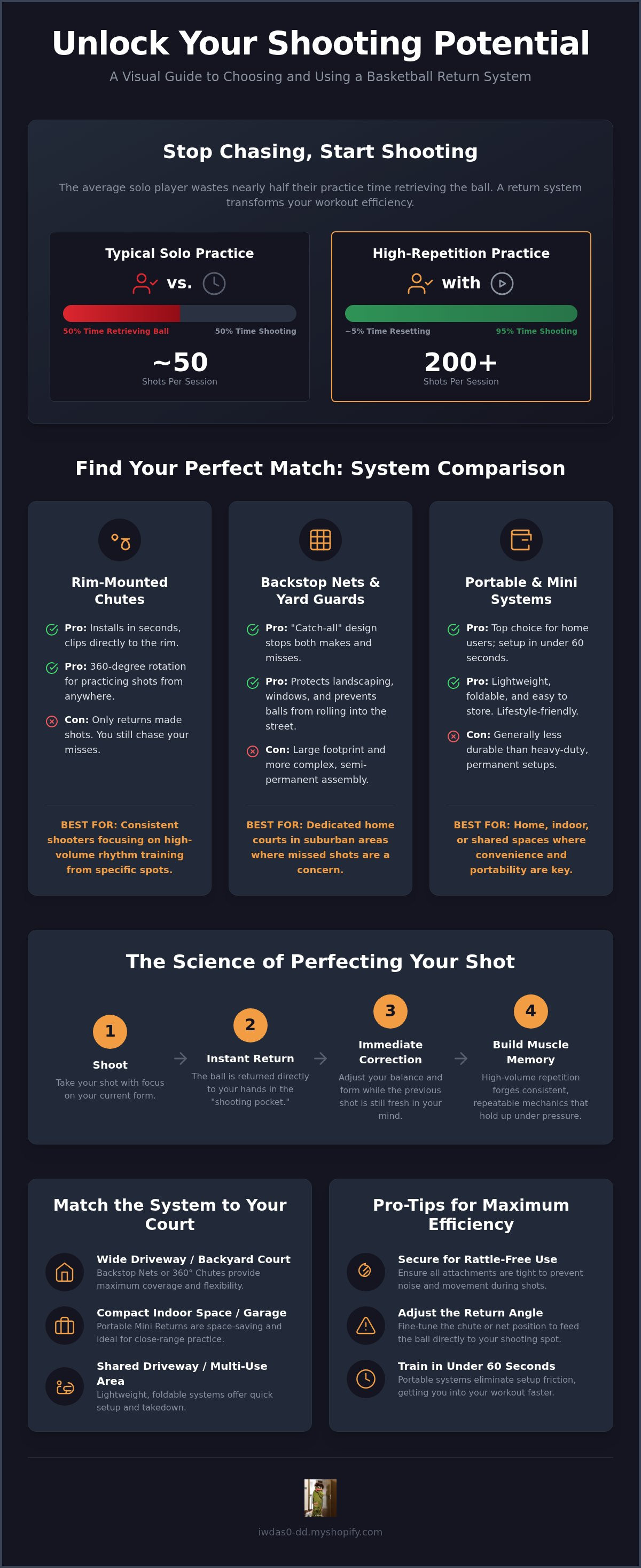
Did you know that the average solo player spends nearly 50% of their practice time just walking to retrieve the ball? It is a silent thief of progress. Every second you spend chasing a rebound is a second you aren't refining your form or building rhythm. Finding the right basketball return system changes the game by keeping the ball in your hands and your eyes on the rim. It turns a disjointed workout into a high-intensity session that actually moves the needle on your skill level.
We know the frustration of losing your touch because you had to chase a long bounce into the grass. It is hard to stay locked in when your practice feels more like a light jog than a shooting drill. This guide will teach you how to select, set up, and master a basketball return system to effectively double your shooting reps and accelerate your development. We will explore how to maximize your specific space, increase your hourly volume, and use repetitive rhythm to build lasting muscle memory. Whether you need a heavy-duty setup or a portable mini return for home use, you are about to transform how you train.
Key Takeaways
- Stop wasting half your practice time and learn how a basketball return system redirects made shots back to your hands for non-stop rhythm.
- Compare the different technologies on the market, from simple chutes to advanced machines, to find the best value for your budget.
- Pick the right setup for your specific environment, whether you have a wide driveway or a compact indoor garage.
- Get professional tips on securing your equipment for a rattle-free experience and adjusting the return angle for maximum efficiency.
- Discover why portable mini returns are the top choice for home users who want to start training in under 60 seconds.
What is a Basketball Return System and Why Do You Need One?
A basketball return system is a specialized tool that captures made shots and redirects them back to the player. It acts as a stationary rebounder. Instead of the ball bouncing away toward the edge of the driveway, it funnels directly back to your hands. It is a simple solution to a frustrating problem. This tool effectively ends the "Solo Practice Paradox." This paradox is the reality where a player spends more energy chasing the ball than actually shooting it.
Consider a typical hour on the court. Without help, you might spend thirty minutes just walking. Your rhythm breaks every time the ball rolls into the grass or under a car. With a basketball return system, you can get 200 shots in the time it usually takes to get 50. It transforms your workout from a series of sprints into a focused shooting clinic. You spend your time catching the ball in the "shooting pocket" and perfecting your footwork, rather than jogging to the curb.
The Science of Muscle Memory in Shooting
Shooting is all about repeatable mechanics. When the ball returns to you instantly, you can make immediate corrections to your form. If your last shot was off-balance, you can fix it three seconds later while the feeling is still fresh in your mind. This is the power of rhythm shooting. Chasing a ball for thirty seconds resets your brain's focus. It creates "dead time" that interrupts the neural pathways you are trying to build. High-volume repetition is the only way to ensure your shot remains consistent under pressure. Immediate feedback allows your muscles to "remember" the correct motion faster than intermittent practice ever could.
Common Problems Solved by Return Systems
These systems solve several practical issues for the home athlete. First, they eliminate the need for a dedicated rebounder. You can practice whenever you want without needing a partner to stand under the rim. Second, they protect your surroundings. The system prevents the ball from rolling into expensive landscaping or into the path of oncoming traffic. Finally, it reduces unnecessary physical fatigue. You should be tired from jumping and shooting, not from running after a loose ball. While elite facilities might use an automated basketball shooting machine, most home players prefer a more accessible setup. A portable mini basketball return game offers a space-saving way to get those professional-level reps in your own backyard.
Comparing Different Return Technologies: Chutes, Nets, and Machines
Choosing the right basketball return system depends on your goals and your court. There isn't a one-size-fits-all answer. Some players want a permanent setup for high-intensity training. Others need something they can tuck away after dinner. Understanding the trade-offs between durability and convenience will help you find the perfect match for your skill level. Whether you are training for the varsity team or just looking for a fun way to stay active, the technology you choose dictates your practice flow.
Rim-Mounted Chutes and Redirectors
These are the simplest options on the market. They clip directly onto the rim or the net hooks. Advanced 360-degree chutes are excellent because you can rotate them to face any spot on the floor. This allows you to practice corner threes or baseline jumpers with the same efficiency as free throws. They are very popular for driveway hoops because they install in seconds. However, there is a catch. Most chutes only return made shots. If you miss, you're back to chasing the ball across the pavement. They are best for players who already have a consistent shot and want to focus on high-volume repetition from specific spots.
Backstop Nets and Yard Guards
If you are a high-intensity shooter, a net system might be better. These "catch-all" designs act as a massive safety net behind the backboard. They are essential for tight suburban spaces where a missed shot could mean a broken window or a ball rolling into street traffic. The price-to-performance ratio is high for dedicated athletes who miss as often as they make. The downside is the footprint. These systems are large and require a more complex assembly. They aren't something you want to move every day. They are built for durability and often stay up through the entire season, making them ideal for serious backyard courts.
Portable and Mini Return Systems
For many, the best balance is found in lightweight, foldable systems. These are designed for recreational use and indoor spaces. Portability is a game-changer if you share your court space or need to clear the driveway for a car. You get the benefit of a return without the permanent clutter. It is a lifestyle-friendly approach to fitness. You can start practicing in under 60 seconds and fold the unit flat when you are done. For those who value a quick setup and space-saving design, a portable mini basketball return game is a fantastic discovery that keeps the game moving without the hassle of heavy equipment.
How to Choose the Right System for Your Home Court Setup
Selecting the right basketball return system isn't just about finding the biggest net. It is about matching a tool to your specific lifestyle and training goals. Before you make a choice, you have to look at the physical reality of your court. The perfect setup for a professional gym is rarely the right fit for a suburban driveway. You need to balance your athletic ambitions with the space you actually have available. Are you a varsity player grinding for a scholarship, or a weekend warrior looking for a more efficient way to stay active? Your answer dictates the durability and versatility you should look for.
Sizing Up Your Practice Area
Start with a tape measure. If you are considering a large net-based system, check your lateral clearance. These setups often extend several feet beyond the backboard to catch stray shots. For those using a shared driveway, a permanent net can be a major nuisance. This is why portable systems are often the better choice for multi-purpose spaces. They provide the return benefits you need without claiming the entire area permanently.
Don't forget to look up. Ensure there are no low-hanging branches or power lines that could interfere with a high-arching ball. If your hoop is outdoors, prioritize weatherproofing. Look for UV-protected netting and powder-coated steel frames. These materials ensure your basketball return system doesn't rust or degrade after a single season of rain and sun. High-quality materials are a personal recommendation for anyone living in a four-season climate.
Budgeting for Performance
You will find a wide range of options on the market. The goal is to find the "sweet spot" between a basic plastic redirector and an industrial machine. Build quality is vital because it affects the "rebound force" of the ball. Lower-end models might just drop the ball at your feet. A well-designed system has enough tension and the correct angle to deliver the ball directly to your shooting pocket. This allows you to maintain your form and footwork without reaching or lunging.
Be mindful of hidden costs. Some large-scale systems require extra weighted anchors, such as sandbags or water bases, to stay stable during heavy use. Others might require specialized tools for assembly. If you value a low-friction experience, a portable mini basketball return game is an excellent discovery. It offers a budget-friendly way to get your reps in without the headache of a complex installation or a massive footprint in your garage.
Step-by-Step: How to Set Up Your Return System for Maximum Efficiency
Setting up your basketball return system correctly is the difference between a smooth session and a noisy distraction. A secure, rattle-free installation ensures you stay focused on the rim. Start by tightening all bolts and clips. If you notice vibration against the backboard, consider adding small rubber washers or foam padding at the contact points. These simple additions dampen sound and prevent the hardware from loosening over time. It makes your practice feel professional and keeps the neighbors happy too.
Safety is a priority. Conduct a quick check to ensure the attachment doesn't block the break-away mechanism of your rim. You don't want a high-impact shot or an occasional dunk to bend the return frame. Once the system is secure, perform a few test shots to check the return path. Adjusting the angle is where you find your rhythm. The goal is to have the ball land consistently in your "shooting pocket" so you can transition into your next shot without resetting your feet.
Installing the System on Your Hoop
Most rim-mounted chutes use standard hooks that latch onto the existing net loops. Center the return path carefully to avoid "dead spots" on the court where the ball might veer off-course. If the ball is falling short of your desired shooting spot, you need to adjust the tray. To ensure the ball reaches the free-throw line consistently, set your return tray at a 45-degree angle relative to the ground. This provides enough arc and momentum for a clean return every time. Regular maintenance is also key. Check the netting once a month to ensure it remains taut, as sagging mesh will slow down the ball's exit speed.
Optimizing Your Solo Workout
Now that your system is ready, use the "10-10-10" drill to build muscle memory. Shoot 10 shots from the left wing, 10 from the top of the key, and 10 from the right wing. The basketball return system lets you cycle through these 30 shots in just a few minutes. It also allows you to master the "catch and shoot." Treat every return as a crisp pass from a teammate. Work on your footwork by stepping into the ball as it arrives. If you are practicing outdoors during the winter months, wearing a heated jacket keeps your shooting arm limber and your core warm. Staying comfortable allows you to extend your sessions and maintain your form even in the cold.
Ready to see how much your shooting percentage can grow? Explore our portable mini basketball return game and start getting the reps you need to dominate the court.
Why Portable Mini Basketball Returns are the Best Choice for Home Use
While heavy-duty nets have their place, the home environment often demands more flexibility. For the average player, the ideal basketball return system is one that integrates into daily life without causing a headache. A "Zero-Friction" setup is the biggest advantage here. It means you can start your drills in under 60 seconds. If a piece of equipment takes twenty minutes to haul out and assemble, it often stays tucked away in the garage. Portable systems remove that mental hurdle. They make it easy to fit in a quick session before dinner or between school runs. You spend your energy on the shot, not the preparation.
Space efficiency is another critical factor for suburban homes. Most driveways are multi-purpose areas. You might need to park a car, host a barbecue, or let younger kids ride their bikes. A portable mini basketball return system is designed for these exact scenarios. It provides the high-repetition training you need without claiming the driveway permanently. It is also remarkably versatile for all ages. You can easily adjust the setup for a child learning the basics or a teenager refining their three-point shot. This flexibility gives players a psychological boost. Practice stops feeling like a chore and starts feeling like a fast-paced game. When the ball keeps coming back, you stay in the flow, and that is where the real improvement happens.
Portability vs. Permanence
Foldable designs are a win for families with limited storage. You have the freedom to move your practice from the driveway to the backyard if the sun is too bright or the wind picks up. This mobility is essential for players who don't want to be tied to a single spot. There are several reasons why choosing a portable model makes sense:
- Quick Storage: Fold it flat and tuck it against the garage wall in seconds.
- Multi-Surface Use: Transition easily from concrete driveways to backyard grass.
- Reduced Friction: The less effort it takes to set up, the more often you will practice.
Reducing the physical effort required to start a workout is the secret to consistency. When your gear is lightweight and easy to handle, you are much more likely to use it every single day. It turns the barrier to entry into an open door for progress. You gain the freedom to train on your terms, regardless of how much space you have.
Discovery and Innovation in Sports Gear
At Green Team Express, Llc, we act as a bridge between high-end professional technology and home-based fun. We curate specialized tools like our Portable Mini Basketball Return Game because they solve real problems for real people. It is about finding that niche solution that fits your specific lifestyle needs. We have done the hard work of searching for items that combine quality with novelty, so you don't have to. Our team values practicality and a sense of wonder in every product we offer. We believe that skill-building should be accessible to everyone, not just those with a full-sized indoor court. Investing in the right tools makes fitness a natural, joyful part of your routine. It is time to stop chasing the ball and start mastering your shot. We invite you to explore our collection and find the perfect fit for your home court today.
Elevate Your Training Today
Mastering your shot requires more than just effort; it requires extreme efficiency. By integrating a basketball return system into your routine, you eliminate the wasted energy of chasing rebounds and replace it with pure, high-volume repetition. You've learned how the right technology can transform a disjointed practice into a fluid, rhythm-heavy session that builds lasting muscle memory. Whether you're adjusting your return angle for free throws or running rapid-fire drills from the wing, your focus remains exactly where it should be: on your form and your follow-through.
Our team has carefully curated tools that bridge the gap between professional-grade tech and home-court convenience. We believe that finding a niche solution for your specific space shouldn't be a struggle. Our portable designs prioritize your active lifestyle, making it easier than ever to start a session in seconds and store it just as quickly. It's time to stop walking and start shooting. Discover our Portable Mini Basketball Return Game and level up your home court today!
Consistency is the true secret to greatness. Keep practicing, stay focused, and watch your shooting percentage soar this season.
Frequently Asked Questions
Will a basketball return system work on any rim?
Most systems are designed to fit standard 18-inch rims found on driveways and professional courts. They usually attach to the net hooks or the rim itself. However, you should check the compatibility if you have a non-standard rim or a breakaway mechanism. Some portable hoops have unique backboard attachments that might require a specific mounting style. Always verify the attachment points before purchasing to ensure a secure fit for your hoop model.
Does the system return missed shots or only made ones?
It depends on the technology you choose. Basic rim-mounted chutes only capture and return made shots. If you miss, you will still need to retrieve the ball manually. If you want to capture missed shots, you should look for backstop nets or yard guard systems. These larger catch-all designs funnel both makes and misses back toward you. This is a vital distinction for players who want to maximize their training volume and focus.
Can I leave my basketball return system outside in the rain?
You can leave many systems outdoors if they are made from weather-resistant materials like powder-coated steel and UV-protected nylon. However, constant exposure to heavy rain or snow will eventually degrade the netting and hardware. For the longest lifespan, we recommend storing your basketball return system indoors when it is not in use. This is where portable, foldable designs shine. They allow for quick storage in a garage or shed, protecting your investment from the elements.
How much space do I need for a full rebounder net?
A full-sized rebounder net typically requires about 10 to 12 feet of lateral space behind and around the backboard. You also need several feet of clearance in front of the hoop for the return path. These systems have a large footprint, making them better suited for spacious backyards rather than narrow driveways. If you have limited room, a compact or portable basketball return system is a much better discovery for your specific home court layout.
Are portable basketball return systems stable enough for adult use?
Yes, portable systems are stable enough for adults when they are anchored correctly. Many models feature a base that you can weight with sand or water to prevent tipping during high-intensity sessions. While they are lighter than permanent professional machines, they are engineered to handle the force of a standard basketball. If you are a heavy hitter, ensure the frame is secure and the netting is taut to maintain a consistent return rhythm during your workout.
How do I stop the return system from vibrating or making noise?
You can stop vibrations by adding rubber washers or small pieces of adhesive foam at the points where the system touches the rim or backboard. These materials act as shock absorbers and significantly reduce the rattle during practice. Ensuring every bolt is tightened during the initial assembly is another simple fix. A quiet system helps you stay focused on your shooting form and keeps your training sessions respectful of your neighbors' peace and quiet.
Is a basketball return system worth it for a beginner?
It is absolutely worth it for a beginner because it allows for rapid skill acquisition. Chasing the ball is discouraging when you are just starting out. A return system keeps you engaged by providing immediate feedback on every shot. It helps you build confidence by allowing you to focus on your stance and follow-through without the constant interruption of a long walk to the curb. It makes the learning process much more enjoyable and efficient.
Can a return system help with my free throw accuracy?
A return system is one of the best tools for improving free throw accuracy. It allows you to stand at the line and receive the ball in your shooting pocket every few seconds. This high-volume repetition is the only way to build the muscle memory required for a consistent stroke. You can practice your entire pre-shot routine with the ball arriving exactly like a pass from a teammate, making your training feel more realistic.